Rooms with lawyers in them
Eve moves the series into rooms where lawyers sit. A hospital is nowhere near Netflix scale, Surya says, yet a single row can injure someone; a bank decides in a blink and then answers to an auditor who wants each decision replayed. The fork is still late versus wrong; only the fear has grown heavier.
Eve pictures one patient file, because the portal looks that way; there is no such file. Emergency room, lab, pharmacy, insurer: each has its own dialect, and none agreed what a blood test is called. Volume is not the enemy; variety is. Skip the dictionary for a clever model and the confident answer describes the wrong Jane. A person in a bed is a now fact; what was billed and paid arrives weeks later on a truck.
Old pipes, FHIR, and a conservative index
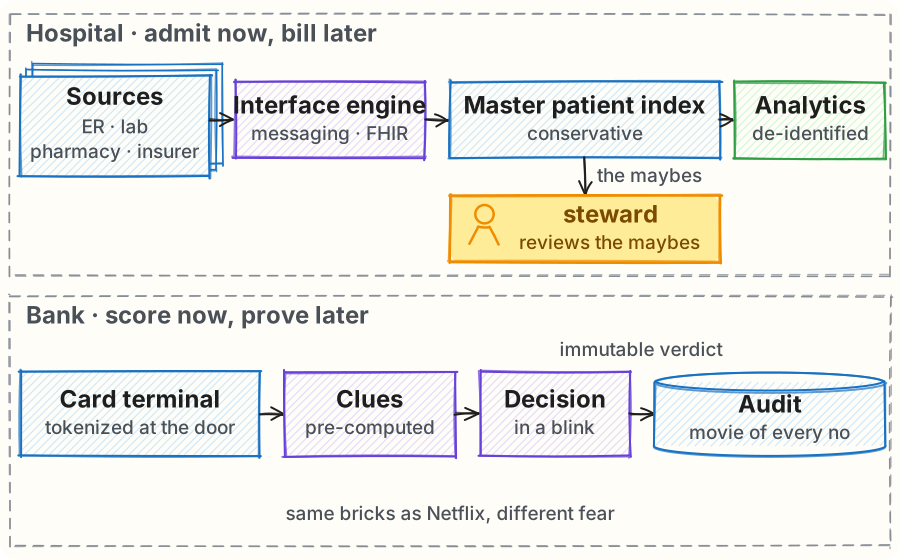
How do the kitchens talk? Poorly, and for decades. When a patient changes beds, clinical systems fire a message in an old standard, Health Level Seven: pipes and positions rather than a tidy web page. Eve hears a conveyor; Surya calls it one with a limp, an interface engine translating dialects and streaming the admit onward. Newer systems use FHIR, pronounced fire, the same job in web shape, yet the old pipes stay, since nobody gets to declare the freight elevator finished. A platform ingests both; the value is in that engine and in identity work, not in any logo.
Then Jane Smith, J. Smith, and Jane Smyth-Jones: one person, three systems. A master patient index tries to assert they are one human, matching on name, birth date, address, and identifiers, and errs toward caution: merging two real patients is a safety failure, so thresholds sit high and a steward reviews the maybes. Refusing a genuine match also hurts, since the allergy then sits in the file nobody opened, but only the false merge becomes a safety incident. Before any readmission model, local lab codes and drug names need mapping onto a shared vocabulary; he offers no percentage, only that this is most of the effort.
HIPAA in practice: masked wherever possible
Eve asks what HIPAA actually forces. Protected health information reaches past the name: a birthday plus a small zip code can single out one resident of a thin town. The working rule: analytics runs on de-identified data whenever it can, and the identified copy is reachable only on a minimum-necessary basis, every access logged. Care teams need the name; a readmissions dashboard does not. Tokenize at the door and do not be the warehouse that also keeps the unmasked chart; anyone who truly needs the real copy passes a narrow door with a named key and a lock that records who turned it. Breach costs, per record and public, make tokenization how you stay off the front page. Eve compresses it: admit now, bill later, never be careless about whose row it is.
The swipe, the cupboard, and the movie of every no
At the card terminal the window is tiny; the score must land before the cashier's patience runs out. Public industry talk places that in tens of milliseconds, which Surya flags as talk, not any bank's real budget. Velocity, distance from the previous swipe, and whether the merchant fits this person's habits are computed ahead of time and looked up fast; scanning fifty past swipes is lake work, and the queue is a concert. It is the Continue Watching cupboard on a crueler clock: a correct decline after she has left is worthless.
Decline a grandmother in Paris and you owe a replay: feature values, model version, threshold, why noon in Paris looked stolen. She will phone; a regulator may ask.
Surya: “If you cannot replay it, you cannot defend it.”
So each scored swipe leaves an immutable verdict, and later training must use the definitions the live scorer used, or the model deceives itself. That is train-serve skew, told as a kitchen mishap: a spoon of salt in the test kitchen, a handful on the line. Feature stores enforce one written recipe for both kitchens; the card is the point, not the brand.
Slow trucks, BCBS 239, and the tiny vault
The bank's slow side is ledgers, capital reports, and proving a figure back to its source. After 2008, regulators decided large banks could not reliably total their own risk, and the Basel Committee's BCBS 239 principles pushed them toward lineage, completeness, and named owners, which Eve translates as a ship's log for a number. Capital, liquidity, and stress work are giant, penny-perfect, change-controlled trucks; edits to a transformation feeding a statement are reviewed and versioned. That is why banks adopted dbt with git: SQL under version control shows an auditor who changed the recipe and when; a stored procedure in one person's head cannot. Audit, not fashion, brought dbt into banks.
Card numbers get tokenized at the perimeter so the analytics platform never touches a real card number; a warehouse inside Payment Card Industry scope was, in his words, designed drunk. Score and store the token; the actual digits remain in the small room that had to exist anyway. Identity recurs in know-your-customer and anti-money-laundering work; the rule holds: do not glue while guessing.
Four newspapers, one map
Surya answers the three recurring questions for all four industries: Netflix fears a bad home screen, the carrier a wrong bill or a leaked location trace, the hospital a merged patient, the bank a figure that cannot be replayed. The same streams, lakes, warehouses, and orchestration are rearranged around fear. Late versus wrong stays the first cut: admit now and bill later, score now and prove later. If one thing survives from these four industries, he says, choose the clock from the failure you cannot live with, and only then the tool.