One play event, several cooks
Eve moves the fork into a living room and under a cell tower. Both businesses are flooded with events, one selling attention and the other minutes and megabytes; only the phone company lives inside the regulator's shadow. The two questions carry over unchanged.
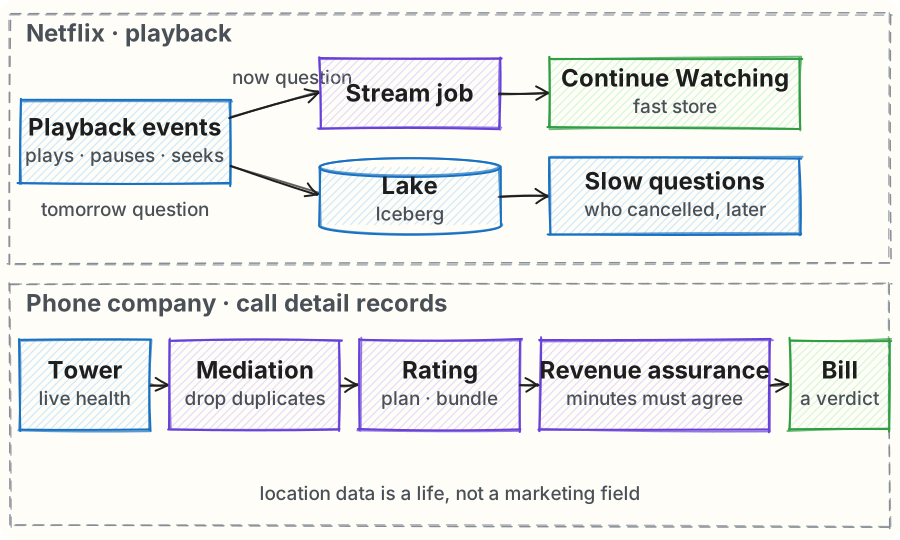
For Netflix, Surya keeps to the public record. Playback is a firehose of plays, pauses, seeks, and hovered artwork; Netflix engineers have written for years about Kafka-style belts and a pipeline named Keystone, and he will not recite a trillions-a-day figure from memory. The shape is what matters: one play event fans out to recommendations, capacity planning, and quality monitoring, none of them calling one another. Glue them together and a slow recommendation model would hold up the cook watching for playback dying. A stale recommendation is tolerable; a slow alarm about failing streams is a bad night for the whole company.
Continue Watching, and why the lake wants a copy
Eve picks the feature she actually notices. The television keeps muttering roughly where you are, and a stream job turns those mutters into one live fact, minute twenty-two, in a fast store the phone reads instantly. The lake gets the same mutter because the resume point is a now question and whether people finished the show is a tomorrow question. A resume point off by a few seconds costs one tap; whether a title kept subscribers spends real money and cannot be messy.
The stations, as shape rather than anyone's diagram: device, event doorway, belt, one job refreshing the low-latency store, the same mutter filed in the lake, and batch jobs later rolling those files into features for the home-screen models. If the stream job dies for ten minutes the belt holds; on restart it replays from its last stamp and a few people land slightly early in an episode. Overnight, the lake copy joins viewing to who canceled after a launch; that is how a show gets valued, and getting it wrong is a bad bet with a studio.
Iceberg: a fridge full of files is not a table
Apache Iceberg started inside Netflix, Surya says, and was later donated to Apache; that is project history, not gossip. Eve asks what misbehaving files mean on a Tuesday. You pretend a folder plus a date is a table until a column is added, yesterday gets rewritten, and two jobs reading at once see two different Tuesdays. The storage is as cheap as ever, but it has stopped being a table. Iceberg puts a genuine ledger in front of the files: which version is current, whether a write committed, how the table looked last Thursday. Eve hears the ship's log: name the version rather than erase Tuesday, so a poisoned nightly load can be rolled back. The files stay in S3, Blob Storage, or Cloud Storage; Iceberg sits above them and Spark, Snowflake, and others share one table, so data is no longer tied to one compute brand. Watch the pain, he says, not the press release.
Honest experiments and dying playback
Netflix speaks publicly about experimentation as infrastructure; Surya will not guess how many tests run. The platform must know which viewer saw which version, or the science is worthless: new artwork only counts as a success if every play, finish, and cancel carries the artwork that person really saw; otherwise you are congratulating a coincidence. So the warehouse keeps the assignment beside the behavior. Playback health is the other don't-be-late: rebuffering or a sour bitrate has to surface while the fire is small, though he declines to invent a paging threshold.
The tower: mediation, rating, and adding it twice
Each call, text, and data session leaves a call detail record, and Surya says it is two things at once, money and a map of your Tuesday: the tower you woke on, the minutes outside a clinic, the corridor of cells on the drive home. It is a diary you never agreed to keep, which is why dumping it in the lake for marketing is a leak, not a personality.
Pickiness starts with mediation. Switches emit ugly vendor dialects, and one call crossing three boxes leaves three partial records; bill all three and one conversation becomes a trilogy. Decode, stitch, and drop the duplicates before the record can be money. Then rating: pricing the call against plan, bundle, and roaming, a merciless batch job because a one-cent slip across a city ends up in a newspaper. Then revenue assurance: minutes the network saw, minutes rated, and minutes billed must agree; any gap is leaked money or an overcharged customer, and both get a person rather than a shrug.
Surya: “The tape is not the invoice until somebody has added it twice.”
Sick cells, location lockers, and the three questions
The live side is telemetry: a choking cell, a sour link, a probable fiber cut. A stream can page a truck, and a false page beats a neighborhood that cannot call out. Location is handled differently: analytics sees a coarsened district, not a sidewalk, while the exact trace sits in a tighter room behind a legal workflow. Retention and privacy law pull opposite ways, so the platform enforces both, lifecycle on the object store and purge in the warehouse; hope, he says, is not a retention policy. The clouds change the logo, not the physics.
Surya: “Continue Watching is allowed to catch up. The invoice is a verdict.”
The closing checklist comes before any tool: which event is money, which error makes the newspaper, and what the regulator will want to see. Eve answers for Netflix, Surya for the carrier, whose regulator asks for the tape and then asks why you still have it.